Nikon NIKKOR Z 85mm f/1.8 vs Nikon NIKKOR Z MC 105mm: Spec Comparison
As an Amazon Associate we earn from qualifying purchases. Links on this page are affiliate links.
The nikon nikkor z 85mm f 1 8 vs nikkor z mc 105mm comparison highlights two distinct prime lenses for your Z series camera. Both offer sharp optics and weather sealing for reliable use in various conditions. The primary difference lies in their design goals. The 85mm lens prioritizes a wider aperture for portraits. The 105mm lens focuses on macro photography with vibration reduction. This affects size, weight, and optimal use cases.
Key differences
| Aspect | Nikon NIKKOR Z 85mm f/1.8 S Lens | Nikon NIKKOR Z MC 105mm f/2.8 VR S |
|---|---|---|
| Focal Length | 85mm | 105mm |
| Maximum Aperture | f/1.8 | f/2.8 |
| Vibration Reduction | not listed | VR (Vibration Reduction) |
| Weight | 1.04 pounds | 1.39 pounds |
| Length | 3.89 inches | 5.6 inches |
Which one should you choose?
Choose Nikon NIKKOR Z 85mm f/1.8 S Lens if
- You want a wider aperture for shallow depth of field in portraits
- You prefer a lighter and more compact lens for travel
- You need a lens primarily for general portrait work
Choose Nikon NIKKOR Z MC 105mm f/2.8 VR S if
- You require 1:1 macro magnification for close-up details
- You need vibration reduction for handheld shooting
- You want a slightly longer reach for insects or nature
Verdict: Choose the 85mm f/1.8 S if you prioritize portraiture and a smaller footprint. Select the 105mm f/2.8 VR S if you need macro capabilities and image stabilization. Both lenses deliver high optical quality for their specific niches.
Nikon 85mm f/1.8 vs 105mm MC 105mm
Maximum Aperture
The Nikon NIKKOR Z 85mm f/1.8 S features a wider maximum aperture of f/1.8. This allows more light to reach the sensor compared to the Nikon NIKKOR Z MC 105mm f/2.8 VR S, which stops at f/2.8. A wider aperture helps you shoot in lower light without raising ISO levels excessively. It also enables a shallower depth of field for stronger background blur. The 85mm lens gives you an advantage for portrait work where isolating the subject is key. The 105mm lens still offers a bright f/2.8 option, which is sufficient for many lighting conditions. However, the f/1.8 setting provides greater flexibility when shooting in dim environments or seeking extreme bokeh effects.
Focal Length
Focal length determines your framing and perspective. The Nikon NIKKOR Z 85mm f/1.8 S is an 85mm lens, a classic choice for portraits. The Nikon NIKKOR Z MC 105mm f/2.8 VR S offers 105mm, which provides slightly more reach. This extra distance is useful for macro photography, allowing you to fill the frame with small subjects like insects or flowers from a comfortable working distance. It also helps avoid casting shadows on your subject. For general portraits, both lengths are flattering, but the 105mm lens gives you a bit more flexibility in tight spaces. The 85mm lens is more compact for everyday carry.
Stabilization
Image stabilization is a significant differentiator between these two lenses. The Nikon NIKKOR Z MC 105mm f/2.8 VR S includes Vibration Reduction (VR) technology. This feature helps reduce camera blur when shooting handheld, allowing you to use slower shutter speeds without sacrificing sharpness. This is particularly useful for macro work where even slight movement can ruin a shot. The Nikon NIKKOR Z 85mm f/1.8 S does not list VR in its specifications. You will need to rely on your camera body's stabilization or a faster shutter speed to avoid blur. If you frequently shoot handheld in low light or close-up scenarios, the VR feature in the 105mm lens is a practical advantage.
Weight and Size
Portability matters for many photographers. The Nikon NIKKOR Z 85mm f/1.8 S is lighter and more compact. It weighs 1.04 pounds and measures 3.89 inches in length. The Nikon NIKKOR Z MC 105mm f/2.8 VR S is heavier at 1.39 pounds and longer at 5.6 inches. The additional weight and size of the 105mm lens come from its complex macro optics and stabilization mechanism. If you plan to carry your camera all day, the 85mm lens is easier to manage. The 105mm lens is more substantial, which may provide a better grip but adds bulk to your kit. Consider your typical shooting style when weighing portability against features.
Intended Use
Each lens is designed for specific photographic tasks. The Nikon NIKKOR Z MC 105mm f/2.8 VR S is a macro lens capable of 1:1 magnification. This allows you to capture life-size images of small subjects, revealing hidden details in nature or products. It is also versatile for portraits due to its 105mm focal length. The Nikon NIKKOR Z 85mm f/1.8 S is a standard portrait prime lens. It excels at capturing people with pleasing background separation but does not offer macro capabilities. If you need to photograph small objects up close, the 105mm lens is the only option. For pure portrait work, the 85mm lens is a dedicated tool optimized for that purpose.
Which Nikon Z lens fits your needs
Portrait photographers wanting creamy bokeh
The Nikon NIKKOR Z 85mm f/1.8 S offers a wider f/1.8 maximum aperture. This lets in more light for low-light situations and creates a shallower depth of field. Its 85mm focal length is ideal for flattering portraits. The nine-blade diaphragm ensures soft, rounded bokeh. You also get a customizable control ring for quick adjustments.
Macro shooters needing life-size detail
The Nikon NIKKOR Z MC 105mm f/2.8 VR S provides 1:1 magnification for life-size macro shots. This reveals hidden details in small subjects. The 105mm focal length offers a comfortable working distance for insects and nature. You also get built-in Vibration Reduction for sharper handheld images. This lens is designed specifically for high-magnification work.
Versatile shooters wanting image stabilization
The Nikon NIKKOR Z MC 105mm f/2.8 VR S includes Vibration Reduction. This helps prevent camera blur when shooting handheld. The lens also features advanced S-Line optics for sharpness and clarity. Its weather sealing protects against dust and moisture. You get a versatile 105mm focal length that works well for both macro and portraits.
The products compared

Nikon NIKKOR Z 85mm f/1.8 S Lens
Best for: portrait photography on Nikon Z cameras
- Lens Mount
- Nikon Z
- Focal Length
- 85mm
- Maximum Aperture
- f/1.8
- Color
- Black
- Lens Type
- Prime
- Dimensions
- 3.89 × 2.95 × 2.95 inches
View on Amazon: Nikon NIKKOR Z 85mm f/1.8 S Lens Affiliate link
The Nikon NIKKOR Z 85mm f/1.8 S is a prime lens for Z series mirrorless cameras. It features a maximum aperture of f/1.8 and an 85mm focal length. The design includes nine aperture blades for smooth bokeh. It also has two ED glass elements and Nano Crystal coating. The build is dust and drip resistant. You get a customizable control ring for quick adjustments.
Pros
- Large f/1.8 maximum aperture for low light
- Nine-blade diaphragm for rounded bokeh
- Dust and drip resistant construction
- Customizable control ring
Cons
- No image stabilization listed in specs
- Not a macro lens like the 105mm
- Heavier than typical kit lenses
Good fit if
- You need a portrait lens with shallow depth of field
- You shoot in environments where dust or moisture is a concern
- You prefer manual control over aperture settings
Skip if
- You require built-in vibration reduction
- You need macro capabilities for close-up detail
- You want a zoom lens for versatility
Verdict: Nikon NIKKOR Z 85mm f/1.8 S delivers sharp portraits with beautiful background separation. It fits photographers who prioritize aperture size and build quality over image stabilization.
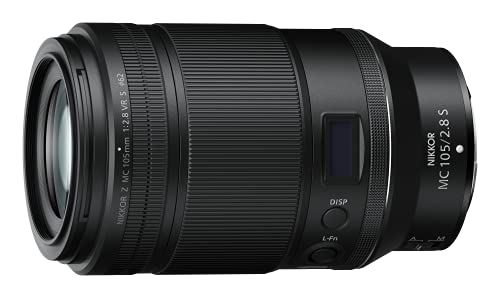
Nikon NIKKOR Z MC 105mm f/2.8 VR S
Best for: Macro photography with handheld stability
- Lens Mount
- Nikon Z
- Focal Length
- 105mm
- Maximum Aperture
- f/2.8
- Color
- Black
- Lens Type
- Prime
- Dimensions
- 5.6 × 3.4 × 5.6 inches
View on Amazon: Nikon NIKKOR Z MC 105mm f/2.8 VR S Affiliate link
This is a professional macro prime lens for Nikon Z mirrorless cameras. It features a 105mm focal length and an f/2.8 maximum aperture. The lens provides 1:1 magnification to reveal hidden details. It includes Vibration Reduction to prevent blur in handheld shots. The weather-sealed build protects against dust and moisture. It suits photographers who need sharp close-ups and a versatile portrait length.
Pros
- 1:1 life-size macro magnification
- 105mm focal length for comfortable working distance
- VR stabilization for handheld shooting
- Weather-sealed construction
Cons
- f/2.8 maximum aperture is slower than f/1.8
- Heavier at 1.39 pounds
- Longer length at 5.6 inches
Good fit if
- You need life-size macro details
- You shoot handheld in variable lighting
- You want a weather-sealed lens
Skip if
- You require ultra-fast f/1.8 apertures
- You prefer a compact travel lens
- You only shoot portraits without macro needs
Verdict: Nikon Z MC 105mm f/2.8 VR S Macro Lens is a specialized tool for macro work. It fits users who prioritize magnification and stabilization over a wider aperture.
Specifications side by side
| Spec | Nikon NIKKOR Z 85mm f/1.8 S Lens | Nikon NIKKOR Z MC 105mm f/2.8 VR S |
|---|---|---|
| Lens Mount | Nikon Z | Nikon Z |
| Focal Length | 85mm | 105mm |
| Maximum Aperture | f/1.8 | f/2.8 |
| Color | Black | Black |
| Aperture | f/1.8 | f/2.8 |
| Lens Type | Prime | Prime |
| Dimensions | 3.89 × 2.95 × 2.95 inches | 5.6 × 3.4 × 5.6 inches |
| Weight | 1.04 pounds | 1.39 pounds |
| Model | 20090 | 20100 |
| Size | not stated | 10.5 centimeter (Pack of 1) |
Frequently asked questions
Is the Nikon Z 85mm f/1.8 S good for portraits?
Yes, this lens is ideal for portrait photography on Nikon Z cameras. Its 85mm focal length and wide f/1.8 aperture allow for sharp subjects with beautiful background separation. The design prioritizes aperture size and build quality, making it a strong choice for capturing detailed portraits.
Does the Nikon Z MC 105mm have image stabilization?
Yes, the Nikon NIKKOR Z MC 105mm f/2.8 VR S includes vibration reduction. This feature provides handheld stability, which is crucial for macro photography where camera shake can ruin sharpness. It fits users who prioritize stabilization and magnification over a wider maximum aperture.
Which lens is heavier, the 85mm or the 105mm macro?
The Nikon Z MC 105mm f/2.8 VR S is heavier. It weighs 1.39 pounds, while the Nikon NIKKOR Z 85mm f/1.8 S weighs 1.04 pounds. The macro lens also has a larger physical footprint, measuring 5.6 inches in length compared to the 85mm lens's 3.89 inches.
Can I use the 85mm f/1.8 for low light?
Yes, the wide f/1.8 maximum aperture allows more light to reach the sensor. This helps in low-light situations without needing high ISO settings. The 85mm focal length also helps isolate subjects, making it suitable for various lighting conditions beyond just portraits.
Is the 105mm lens a prime or zoom?
The Nikon NIKKOR Z MC 105mm f/2.8 VR S is a prime lens. It has a fixed focal length of 105mm. This specialization allows for high magnification capabilities, making it a dedicated tool for macro work rather than a versatile zoom lens.
What is the maximum aperture of the 105mm macro lens?
The maximum aperture is f/2.8. This is narrower than the f/1.8 aperture found on the 85mm lens. While it lets in less light, the f/2.8 setting is optimized for the lens's primary function, which is high-magnification macro photography.
Which lens is better for handheld macro shots?
The Nikon Z MC 105mm f/2.8 VR S is better for handheld macro shots. It features vibration reduction to counteract camera shake. This stabilization is essential when shooting at close distances, ensuring you get sharp images without a tripod.