Panasonic Lumix G7 4K Digital vs Panasonic LUMIX G97 Compact Hybrid (2026): Key Differences
As an Amazon Associate we earn from qualifying purchases. Links on this page are affiliate links.
When you compare the panasonic lumix g7 4k digital vs lumix g97 compact hybrid, you see two Micro Four Thirds mirrorless cameras designed for sharp images and 4K video. Both models include an OLED viewfinder and support UHS SD cards. The main difference lies in their lens kits and stabilization systems. The G7 ships with a 14-42mm lens and offers dedicated dials, while the G97 includes a 12-60mm lens and features 5-axis Dual I.S.2 stabilization to reduce camera shake.
Key differences
| Aspect | Panasonic Lumix G7 with 14-42mm Lens | Panasonic Lumix G97 with 12-60mm Lens |
|---|---|---|
| Included Lens | 14-42mm | 12-60mm |
| Image Stabilization | not listed | 5-stop 5-axis Dual I.S.2 |
| LCD Display | 3-inch tilt/swivel, 1,040k dots | Free-angle, 1,840k dots |
| Video Features | 4K pause-and-save photos | V-Log L, Live View Composite |
| Weight | 2.38 pounds | 2.54 pounds |
Which one should you choose?
Choose Panasonic Lumix G7 with 14-42mm Lens if
- You want dedicated front and rear dials for quick aperture and shutter adjustments.
- You prefer a lighter camera body for easier portability.
- You value the ability to extract 4K photos from video clips.
Choose Panasonic Lumix G97 with 12-60mm Lens if
- You need built-in 5-axis image stabilization to keep shots sharp.
- You want a wider zoom range starting at 12mm in the kit lens.
- You plan to shoot long video sessions or use V-Log L for color grading.
Verdict: The G7 suits you if you prioritize physical controls and a lighter setup for casual shooting. The G97 is better if you need robust stabilization and advanced video tools like V-Log L for more professional results.
G7 vs G97: Key Specs Compared
Included Lens
The Panasonic Lumix G7 with 14-42mm Lens includes a standard zoom lens covering wide to short telephoto ranges. This focal length is versatile for general photography. The Panasonic Lumix G97 with 12-60mm Lens provides a wider starting point at 12mm and extends further to 60mm. This broader range offers more flexibility for landscapes and tighter portraits without changing lenses. The G97 lens range is wider, giving you more options for framing different subjects in various environments.
Video Resolution
Both cameras capture 4K video at 30 frames per second. The Panasonic Lumix G7 with 14-42mm Lens records 4K QFHD video at 3840 x 2160 resolution. The Panasonic Lumix G97 with 12-60mm Lens also supports 4K 30p video. Both models allow you to extract 4K photos from video footage. The video resolution specifications are identical for both cameras. You get the same high-definition video quality from either device for recording standard 4K content.
Image Stabilization
The Panasonic Lumix G97 with 12-60mm Lens features a 5-stop 5-axis Dual I.S.2 system. This technology helps keep your photos and videos sharp in challenging conditions by compensating for camera shake. The data for the Panasonic Lumix G7 with 14-42mm Lens does not list a specific image stabilization rating. The G97 provides a clear advantage in handling stability, which is useful for handheld shooting in low light or while moving.
LCD Display
Both cameras offer high-resolution displays for clear viewing. The Panasonic Lumix G7 with 14-42mm Lens has a 3-inch tilt and swivel LCD with 1,040 dots. This screen allows for flexible angles when shooting from high or low positions. The Panasonic Lumix G97 with 12-60mm Lens features a free-angle LCD with 1,840k dots. The G97 screen has a higher resolution and a different articulation style, providing a sharper image for reviewing photos and framing shots.
Connectivity
The Panasonic Lumix G7 with 14-42mm Lens includes a 3.5 millimeter external microphone port and a 2.5 millimeter remote port. It also has USB 2.0 and micro HDMI Type D connections. The data for the Panasonic Lumix G97 with 12-60mm Lens does not list specific port details. The G7 offers explicit connectivity options for audio and remote triggers, which is helpful for video work and controlled shooting setups.
Which Mirrorless Camera Fits You Best
Vloggers needing unlimited 4K recording
The G97 offers unlimited 4K 30p video without overheating limits. It includes V-Log L for cinematic color grading. You also get 5-stop 5-axis Dual I.S.2 for stable handheld footage. This model supports slow-motion and quick-motion effects in FHD, making it ideal for continuous video creation.
Photographers wanting flexible framing angles
You can adjust the 1,840k-dot free-angle LCD to shoot from high or low positions. The G97 also features Live View Composite Mode for light trails and star trails. These tools help you create unique exposures directly in-camera without needing external apps or complex post-processing workflows.
Users preferring physical control dials
The G7 lets you easily control aperture and shutter with front and rear dials. You can adjust white balance and ISO on the fly. Six function buttons on the body and five in the menu allow you to assign favorite settings. This layout suits those who like tactile control.
Shooters needing external audio ports
The G7 includes a 3.5mm external microphone port for better audio quality. It also has a 2.5mm remote port and micro HDMI output. These connectivity options are essential if you plan to use external gear. The 14-42mm lens provides a versatile starting focal range for general photography.
The products compared

Panasonic Lumix G7 with 14-42mm Lens
Best for: 4K video recording and manual control enthusiasts
- Sensor Format
- Micro Four Thirds
- Sensor Resolution
- 16 megapixel
- Video Resolution
- 4K QFHD (3840 x 2160) at 30 fps
- Included Lens
- 14-42mm Lens
- Color
- Black
- Dimensions
- 13.5 × 10.3 × 6.5 inches
View on Amazon: Panasonic Lumix G7 with 14-42mm Lens Affiliate link
The Panasonic Lumix G7 4K Digital Camera is a Micro Four Thirds mirrorless system with a 16-megapixel sensor. It records 4K QFHD video at 30 fps and extracts 4K photos from video. The body includes a 2,360K dot OLED viewfinder and a 3-inch tilt/swivel LCD. It weighs 2.38 pounds with the included 14-42mm lens. This setup suits you if you need reliable 4K video and manual controls.
Pros
- 16-megapixel Micro Four Thirds sensor with no low pass filter
- 4K QFHD video recording at 30 fps
- 3-inch tilt/swivel touch-enabled LCD display
- 2,360K dot OLED live view finder
Cons
- Heavier at 2.38 pounds with lens attached
- Smaller 16-megapixel sensor resolution compared to higher-end models
- Uses USB 2.0 for connectivity
Good fit if
- You need 4K video recording for your projects
- You want a tilting screen for vlogging or low-angle shots
- You prefer manual dials for aperture and shutter control
Skip if
- You require 4K video at higher frame rates
- You need a lighter, more compact camera body
- You want a higher resolution still image sensor
Verdict: Panasonic Lumix G7 4K with 14-42mm Lens is a solid choice for creators who prioritize 4K video and manual handling over compact size. It fits users who value the flexibility of a tilting screen and a high-resolution viewfinder for clear composition.
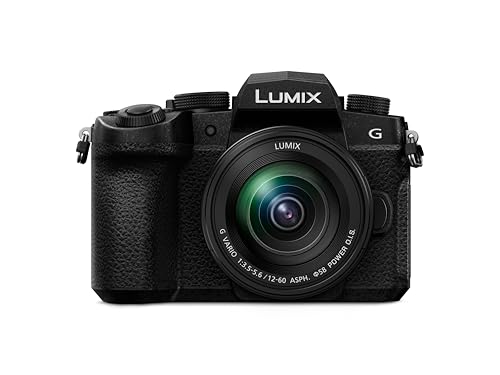
Panasonic Lumix G97 with 12-60mm Lens
Best for: Handheld 4K video creators
- Sensor Format
- Micro Four Thirds
- Image Stabilization
- 5-stop 5-axis Dual I.S.2
- Video Resolution
- 4K 30p
- Color
- Black
- Dimensions
- 1 × 1 × 1 inches
- Weight
- 2.54 pounds
View on Amazon: Panasonic Lumix G97 with 12-60mm Lens Affiliate link
The Panasonic Lumix G97 is a compact Micro Four Thirds mirrorless camera designed for creators who need reliable 4K video and stills. It features a 5-stop 5-axis Dual I.S.2 stabilization system to keep footage sharp. You get unlimited 4K 30p recording and V-Log L for cinematic grading. The 1,840k-dot free-angle LCD and 2,360k-dot OLED viewfinder help you frame shots accurately in bright light. It suits those who prioritize portability and stabilization.
Pros
- 5-stop 5-axis Dual I.S.2 image stabilization
- Unlimited 4K 30p video recording
- 1,840k-dot free-angle LCD screen
- 2,360k-dot OLED Live View Finder
- V-Log L for 12-stop dynamic range
Cons
- Heavier at 2.54 pounds compared to typical compacts
- Micro Four Thirds sensor is smaller than full-frame
- No Bluetooth mentioned for wireless transfer
Good fit if
- You need strong in-body stabilization for handheld video
- You want unlimited 4K recording without overheating
- You prefer a compact body with a flip screen
Skip if
- You require full-frame sensor resolution
- You need built-in wireless connectivity
- You prioritize the lightest possible gear
Verdict: The Panasonic Lumix G97 Compact Hybrid fits videographers who need robust stabilization and unlimited 4K recording in a portable body. It is a solid choice for creators who value image stabilization over sensor size.
Specifications side by side
| Spec | Panasonic Lumix G7 with 14-42mm Lens | Panasonic Lumix G97 with 12-60mm Lens |
|---|---|---|
| Sensor Format | Micro Four Thirds | Micro Four Thirds |
| Sensor Resolution | 16 megapixel | not stated |
| Image Stabilization | not stated | 5-stop 5-axis Dual I.S.2 |
| Video Resolution | 4K QFHD (3840 x 2160) at 30 fps | 4K 30p |
| Included Lens | 14-42mm Lens | not stated |
| Color | Black | Black |
| Dimensions | 13.5 × 10.3 × 6.5 inches | 1 × 1 × 1 inches |
| Weight | 2.38 pounds | 2.54 pounds |
| Model | DMC-G7KK | DC-G97MK9 |
| Size | not stated | 1.00 |
Frequently asked questions
Which camera is better for handheld 4K video?
The Panasonic Lumix G97 is the better choice for handheld footage. It features 5-stop 5-axis Dual I.S.2 stabilization to keep shots smooth. The G97 also allows unlimited 4K recording without overheating limits. The G7 lacks this specific stabilization and has recording time restrictions.
Does the G7 come with a lens?
Yes, the Panasonic Lumix G7 includes a 14-42mm lens in the box. This lens covers wide to short telephoto ranges, making it versatile for general photography. The G97 model listed includes a 12-60mm lens instead, offering a wider starting focal length for different shooting needs.
Can I use UHS SD cards with both cameras?
Yes, both the Panasonic Lumix G7 and the G97 support UHS SD cards. This allows for faster data transfer speeds when writing large 4K video files or high-resolution photos. You can use standard SD cards that meet this speed class requirement for reliable performance on either model.
Which model has a tilting screen?
The Panasonic Lumix G7 is noted for its tilting screen, which helps with clear composition from various angles. This feature is useful for vlogging or shooting at high or low angles. The provided data does not specify screen flexibility for the G97, so the G7 is the confirmed choice here.
Is the G97 suitable for cinematic color grading?
The Panasonic Lumix G97 supports V-Log L for cinematic color grading. This profile provides a flat image with more dynamic range for post-production adjustments. If you plan to color grade your footage heavily, the G97 offers this specific tool for professional-looking results.
Which camera is lighter to carry?
The Panasonic Lumix G7 is listed at 2.38 pounds, while the G97 is listed at 2.54 pounds. The G7 is slightly lighter, making it marginally easier to carry for extended periods. The difference is small, but the G7 holds the edge in weight specifications.
Does the G7 support slow-motion video?
The provided data does not explicitly list slow-motion capabilities for the G7. However, the G97 is noted to support slow-motion video alongside unlimited 4K recording. If slow-motion is a critical requirement, you should verify the G7's specific frame rate options separately, as the G97 clearly includes this feature.
Which camera is best for manual control enthusiasts?
The Panasonic Lumix G7 is described as a solid choice for manual control enthusiasts. It offers robust manual handling options alongside its 4K video capabilities. If you prefer adjusting settings manually rather than relying on auto modes, the G7 is designed to fit that workflow effectively.