Full Frame vs Aps-C Mirrorless Cameras in 2026: Key Differences
As an Amazon Associate we earn from qualifying purchases. Links on this page are affiliate links.
Choosing between full frame vs APS-C mirrorless camera options depends on your specific needs. Both the Canon EOS R8 and Sony Alpha ZV-E10 offer 24.2 megapixel sensors for high-resolution images. The main difference lies in sensor size and intended use. The Canon features a full-frame sensor, while the Sony uses an APS-C sensor. This impacts image quality, lens compatibility, and video capabilities for your projects.
Key differences
| Aspect | Canon EOS R8 Full-Frame Camera | Sony Alpha APS-C Vlog Camera |
|---|---|---|
| Sensor Format | Full-frame | APS-C |
| Configuration | Body Only | Body Only |
| Intended Use | General Photography | Vlogging |
| Image Processor | DIGIC X | BIONZ X |
| Video Resolution | 4K up to 60 fps | 4K |
Which one should you choose?
Choose Canon EOS R8 Full-Frame Camera if
- You prioritize a larger full-frame sensor for better low-light performance and dynamic range.
- You need advanced autofocus with subject detection for people, animals, and vehicles.
- You want uncropped 4K video oversampled from 6K for higher detail.
Choose Sony Alpha APS-C Vlog Camera if
- You focus on vlogging and need features like background defocus and product showcase modes.
- You prefer a camera optimized for easy live streaming via a single USB cable.
- You want a lighter APS-C option for portable video content creation.
Verdict: The Canon EOS R8 suits photographers who need full-frame image quality and advanced autofocus. The Sony Alpha ZV-E10 is better for vloggers who prioritize video-specific features and ease of streaming. Your choice depends on whether you prioritize still image performance or video convenience.
Full Frame vs APS-C Comparison
sensor format
The Canon EOS R8 uses a full-frame sensor, while the Sony Alpha ZV-E10 uses an APS-C sensor. Both cameras share the same 24.2 megapixel resolution. A full-frame sensor typically offers better low-light performance and a shallower depth of field. The APS-C sensor is smaller, which often results in a longer effective focal length for telephoto lenses. This difference affects how you frame your shots and how much background blur you can achieve. If you prioritize image quality in challenging lighting, the larger sensor in the Canon is advantageous. For general photography, the APS-C option remains a capable choice with its own optical characteristics.
video resolution
Both cameras record 4K video, but their capabilities differ in frame rates and processing. The Canon EOS R8 captures uncropped 4K video at up to 60 fps, oversampled from 6K. It also supports Full HD recording at up to 180 fps for slow-motion effects. The Sony Alpha ZV-E10 records 4K video oversampled from 6K with full pixel readout and no pixel binning. While the Sony offers high-quality 4K, the Canon provides higher frame rates for both 4K and Full HD. This gives you more flexibility for smooth slow-motion footage. If you need high-speed slow-motion, the Canon has the edge. For standard 4K content, both deliver strong results.
configuration
The Canon EOS R8 is listed as a body-only configuration. This means you must purchase a lens separately. The Sony Alpha ZV-E10 is also described primarily as a camera body, though it is often sold with lens kits. The data for the Sony does not explicitly list an included lens in its core attributes, focusing on the camera itself. Buying a body-only setup allows you to choose lenses that fit your specific budget and needs. However, it requires an additional investment upfront. If you want a complete package right away, you may need to look for bundle options. The Canon’s body-only status is clear, while the Sony’s typical kit availability varies by retailer.
intended use
The Sony Alpha ZV-E10 is explicitly marketed as a vlog camera. It includes features like a Product Showcase Setting for focus transitions and a Background Defocus button. These tools are designed for content creators who need quick, one-handed operation. The Canon EOS R8 is positioned as a general-purpose mirrorless camera. It focuses on high image quality, fast autofocus, and versatile video formats like Canon Log 3. While the Canon can vlog, it lacks the specialized vlog-centric buttons and modes found on the Sony. If your primary goal is creating video content for social media, the Sony’s design is more practical. For general photography and video, the Canon is more flexible.
connectivity
The Sony Alpha ZV-E10 supports easy live streaming with a single USB cable, requiring no extra hardware or software. This makes it convenient for direct broadcasting to platforms. The Canon EOS R8 supports UVC and UAC protocols, allowing it to function as a webcam and for audio streaming. Both cameras offer straightforward connectivity for computer use. The Sony’s approach is simpler for beginners who want to stream immediately. The Canon’s protocol support offers more technical flexibility for advanced setups. If you plan to stream frequently, the Sony’s plug-and-play design is user-friendly. The Canon’s compatibility ensures it works well with existing computer audio and video setups.
Which Mirrorless Camera Suits You
You want the lightest full-frame body
The Canon EOS R8 is Canon’s lightest full-frame RF mount camera. It weighs 2.15 pounds and measures 6 by 4 by 3 inches. Its compact design makes it easy to carry. The DIGIC X processor supports high image quality with low noise at high ISO speeds. You get a vari-angle LCD touchscreen and a 0.39-inch OLED EVF for flexible shooting angles.
You prioritize vlogging and live streaming
The Sony Alpha ZV-E10 is designed for vloggers. It features a Product Showcase setting that transitions focus from your face to an object. A dedicated Background Defocus button lets you toggle bokeh effects instantly. You can start live streaming with a single USB cable without extra hardware or software. This setup simplifies your content creation workflow significantly.
You need advanced autofocus tracking
The Canon EOS R8 uses Dual Pixel CMOS AF II with 1,053 AF zones. It covers 100% by 100% of the frame. Deep learning technology automatically detects people, animals, vehicles, aircraft, trains, and horses. This extensive subject detection helps you keep fast-moving subjects in sharp focus. The system improves rolling shutter performance when panning quickly.
You prefer a smaller handheld size
The Sony Alpha ZV-E10 is compact and lightweight at 2 pounds. Its dimensions are 2.5 by 6.7 by 4.5 inches. The APS-C sensor with BIONZ X processor delivers 4K video oversampled from 6K. This combination provides high-resolution footage in a small form factor. The body-only configuration allows you to choose your preferred lens size for portability.
Quick picks
| # | Product | Best for | Price |
|---|---|---|---|
| 1 | Canon EOS R8 Full-Frame Camera | Travelers seeking full-frame quality in a compact body | Check price of Canon EOS R8 Full-Frame Camera on Amazon |
| 2 | Sony Alpha APS-C Vlog Camera | Vloggers needing 4K oversampled video and USB streaming | Check price of Sony Alpha APS-C Vlog Camera on Amazon |
The products compared
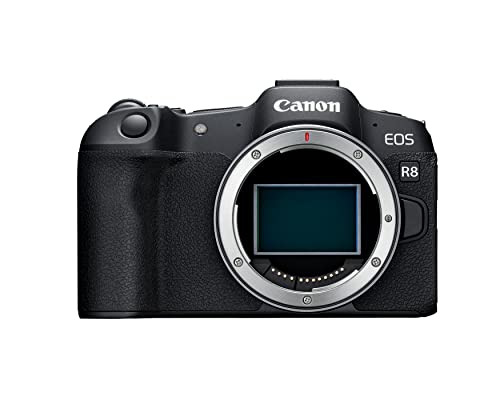
Canon EOS R8 Full-Frame Camera
Best for: Travelers seeking full-frame quality in a compact body
- Sensor Format
- Full Frame (what this guide is about)
- Sensor Resolution
- 24.2 MP
- Autofocus System
- Dual Pixel CMOS AF II (1,053 AF zones)
- Video Resolution
- 4K up to 60 fps, Full HD up to 180 fps
- Image Processor
- DIGIC X
- Configuration
- Body Only
View on Amazon: Canon EOS R8 Full-Frame Camera Affiliate link
The Canon EOS R8 is a compact full-frame mirrorless camera weighing 2.15 pounds. It features a 24.2 MP sensor and DIGIC X processor for high image quality. You get uncropped 4K video at 60 fps and advanced Dual Pixel CMOS AF II with 1,053 zones. The body includes a vari-angle LCD and an OLED viewfinder. It suits photographers who want full-frame quality in a lightweight package.
Pros
- Full-frame 24.2 MP CMOS sensor
- Uncropped 4K video at 60 fps
- Dual Pixel CMOS AF II with 1,053 zones
- Lightweight 2.15 pound body
Cons
- Smaller sensor compared to other full-frame options
- Heavier than APS-C mirrorless cameras
- Sold as body only without a lens
Good fit if
- You prioritize full-frame image quality
- You need a lightweight camera body
- You shoot 4K video at 60 fps
Skip if
- You require an APS-C sensor
- You need a camera with a built-in lens
- You prefer a lighter mirrorless option
Verdict: Canon EOS R8 Full-Frame Mirrorless delivers full-frame resolution and advanced autofocus in a compact body, making it ideal for travelers who want high-quality images without the bulk of larger cameras.

Sony Alpha APS-C Vlog Camera
Best for: Vloggers needing 4K oversampled video and USB streaming
- Sensor Format
- APS-C (what this guide is about)
- Sensor Resolution
- 24.2MP
- Video Resolution
- 4K
- Image Processor
- BIONZ X
- Intended Use
- Vlogging
- Color
- Black
View on Amazon: Sony Alpha APS-C Vlog Camera Affiliate link
The Sony ZV-E10 is an APS-C mirrorless camera designed for vloggers. It uses a 24.2MP sensor and BIONZ X processor. The camera records 4K video oversampled from 6K. It includes a Background Defocus button for quick bokeh control. You can live stream via a single USB cable. This model suits creators who need easy video workflows and compact handling.
Pros
- 24.2MP APS-C Exmor CMOS sensor
- 4K video oversampled from 6K with no pixel binning
- Background Defocus button for instant bokeh toggle
- Easy live streaming via single USB cable
Cons
- APS-C sensor is smaller than full-frame options
- Body weighs 2 pounds, adding bulk
- No mention of built-in electronic viewfinder
Good fit if
- You prioritize video recording over photo resolution
- You want simple live streaming setup
- You need quick focus transitions for product showcases
Skip if
- You require full-frame sensor depth of field
- You need a built-in viewfinder for bright sun
- You prefer a lighter body under 1.5 pounds
Verdict: Sony ZV-E10 APS-C Vlogging Camera fits vloggers who value 4K oversampled video and simple streaming over full-frame image quality.
Specifications side by side
| Spec | Canon EOS R8 Full-Frame Camera | Sony Alpha APS-C Vlog Camera |
|---|---|---|
| Sensor Format | Full-frame | APS-C |
| Sensor Resolution | 24.2 MP | 24.2MP |
| Autofocus System | Dual Pixel CMOS AF II (1,053 AF zones) | not stated |
| Video Resolution | 4K up to 60 fps, Full HD up to 180 fps | 4K |
| Image Processor | DIGIC X | BIONZ X |
| Configuration | Body Only | not stated |
| Resolution | 24.2 MP | not stated |
| Intended Use | not stated | Vlogging |
| Color | Black | Black |
| Lens Mount | Canon RF Mount | not stated |
| Dimensions | 3 × 6 × 4 inches | 4.5 × 2.5 × 6.7 inches |
| Weight | 2.15 pounds | 2 pounds |
| Model | EOS R8 | ZV-E10 |
Frequently asked questions
Is full frame better than APS-C for portraits?
Full frame sensors generally produce a shallower depth of field, which helps isolate subjects from the background. This effect is often preferred for portrait photography. The Canon EOS R8 features a full-frame sensor, allowing you to achieve this look. APS-C sensors like the one in the Sony ZV-E10 can also create background blur, but the effect is less pronounced at the same aperture.
Which sensor is better for low light shooting?
Full frame sensors typically handle low light better due to their larger surface area. Larger sensors capture more light, reducing noise in dim conditions. The Canon EOS R8 uses a full-frame sensor, making it suitable for challenging lighting. While the Sony ZV-E10 has a smaller APS-C sensor, it still offers high resolution. However, the full-frame option usually provides cleaner images in dark environments.
Does APS-C have a crop factor?
Yes, APS-C sensors have a crop factor that affects your field of view. This means lenses appear to have a longer focal length. For example, a 50mm lens on an APS-C camera acts like a longer lens. The Sony ZV-E10 uses an APS-C sensor, so you get this crop effect. Full-frame cameras like the Canon EOS R8 do not have this crop, providing the true focal length of the lens.
Can I use full frame lenses on APS-C cameras?
You can often use full frame lenses on APS-C bodies, but the field of view changes. The APS-C sensor crops the image, effectively increasing the focal length. The Sony ZV-E10 accepts APS-C lenses, but full-frame lenses will also work with this crop. The Canon EOS R8 uses the RF mount for full-frame lenses. Always check mount compatibility before mixing sensor formats and lenses.
Is the Canon EOS R8 good for travel?
The Canon EOS R8 is designed for travelers who want quality without bulk. It weighs 2.15 pounds and measures 6 by 4 by 3 inches. This compact body makes it easy to carry. It features a full-frame sensor for high-resolution images. You get advanced autofocus in a portable package. It is ideal if you prioritize image quality and portability over size.
Is the Sony ZV-E10 suitable for vlogging?
The Sony ZV-E10 is built for vloggers who need reliable video features. It records 4K oversampled video for sharp details. It also supports USB streaming for live broadcasts. The camera weighs 2 pounds and measures 6.7 by 4.5 by 2.5 inches. Its APS-C sensor delivers good image quality. It is a practical choice for content creators focused on video rather than still photography.