Sensor Format Explained: What It Means for Mirrorless Cameras
As an Amazon Associate we earn from qualifying purchases. Links on this page are affiliate links.
Understanding Sensor Formats in Mirrorless Cameras
The sensor format explained reveals how the image capture area size affects your results. This specification defines the physical dimensions of the light-sensitive chip inside your camera. It is the single most important factor determining image quality, low-light performance, and lens compatibility. You will see three main sizes in the mirrorless market: full frame, APS-C, and Micro Four Thirds. Each format has distinct advantages for different shooting styles.
Full frame sensors measure approximately 36 by 24 millimeters. This size matches the classic 35mm film standard. A larger sensor gathers more light. This results in cleaner images in dim conditions and a shallower depth of field. You get more control over background blur. Full frame bodies are often heavier and more expensive. They require larger, heavier lenses to cover the wide image circle.
APS-C sensors are smaller, typically around 23.6 by 15.6 millimeters. This format is common in entry-level and mid-range mirrorless cameras. The smaller size allows for more compact camera bodies. You save weight and money. APS-C lenses are generally lighter and cheaper. There is a crop factor of about 1.5x or 1.6x. This means a 50mm lens behaves like a 75mm lens. You get extra reach for wildlife or sports photography.
Micro Four Thirds sensors measure 17.3 by 13 millimeters. This system uses a shorter flange distance. It allows for very small lenses and cameras. The crop factor is 2x. A 25mm lens acts like a 50mm lens. This system is popular for video and travel. You get excellent stabilization and portability. The trade-off is slightly more noise in very dark scenes compared to larger sensors.
Choosing the right format depends on your priorities. Do you need maximum image quality and bokeh? Or do you prefer lightweight gear for travel? The sensor size dictates your entire system. Consider your lens budget and physical comfort. The format choice shapes your photography experience.
Choose Your Sensor Format
Full Frame
Full frame sensors match the classic 35mm film size. This larger surface area captures more light, which improves low-light performance and dynamic range. You get shallower depth of field for background blur. The Canon EOS R8 offers 24.2 MP resolution in a compact body. It weighs 2.15 pounds. Sony’s a7 III provides professional specs with 1.43 pounds of weight. Larger sensors require bigger lenses. This adds bulk and cost to your kit. You trade portability for image quality. Choose this if you prioritize maximum sensor size and video specs over lens kit inclusion. It fits users who need professional full-frame specs in a durable body. You accept larger gear for better results.
APS-C
APS-C sensors are smaller than full frame but larger than Micro Four Thirds. They offer a good balance of image quality and size. The Sony ZV-E10 uses this format for vlogging. It weighs 2 pounds and measures 2.5 by 6.7 inches. It delivers 4K oversampling clarity. The Canon EOS Rebel T7 is an APS-C DSLR. It weighs 1.05 pounds. It offers 24.1 MP images for casual shooters. APS-C lenses are generally smaller and lighter. You gain reach with a crop factor. This suits vloggers needing lightweight bodies. It also fits beginners wanting a full bundle. You trade some low-light performance for a more manageable size and cost.
Micro Four Thirds
Micro Four Thirds sensors are the smallest common format. They allow for very compact camera bodies and lenses. The Panasonic Lumix G7 is a compact option. It weighs 2.85 pounds. It delivers solid 4K video and a versatile touchscreen. The OM System OM-3 includes internal ND filters. It weighs 3.34 pounds in a kit. This format suits handheld shooting in bright light. You get excellent stabilization options. The trade-off is smaller sensor size. This affects low-light performance compared to larger formats. Choose this if you value portability and video performance over maximum still image resolution. It fits travelers who need small gear.
Who Needs This Spec?
Who needs it
You should prioritize sensor format if image quality is your primary concern. Full frame sensors offer superior low-light performance because they capture more light. This results in cleaner images with less noise in dark environments. You also gain access to shallower depth of field, allowing for distinct background blur in portraits. If you shoot in challenging lighting or desire professional-grade bokeh, this specification directly impacts your creative control. APS-C sensors provide a balanced approach, offering good image quality in a compact body. This format suits travelers who need portability without sacrificing too much performance. Micro Four Thirds cameras are ideal for video creators who value smaller, lighter lenses. If you prioritize mobility and video capabilities over maximum low-light sensitivity, this smaller format meets your needs efficiently.
Who can skip it
You can ignore sensor format if you prioritize system size and cost efficiency. Many modern APS-C and Micro Four Thirds cameras deliver excellent results for everyday photography. If you shoot in well-lit conditions, the difference in low-light performance becomes negligible. You may not notice the extra dynamic range in typical daylight scenarios. Budget-conscious buyers often find smaller formats offer better value for money. You can invest those savings into better lenses or accessories. If you are new to photography, learning composition and exposure matters more than sensor size. A smaller, lighter camera encourages you to carry it more often. This habit improves your skills faster than owning a larger, heavier body. Focus on lens selection and technique first. You can always upgrade the sensor later if your needs change significantly.
Mirrorless Camera Glossary
Sensor Format
The physical size of the image sensor, such as full frame or APS-C. Larger sensors capture more light for better low-light performance and dynamic range.
Resolution
The number of megapixels on the sensor, like 24.2 MP. Higher resolution allows for larger prints and more detail, but requires more storage space.
Video Resolution
The clarity of recorded video, such as 4K or 1080p. Higher resolutions provide sharper footage but demand faster memory cards and more processing power.
Included Lens
A lens bundled with the camera body, often a kit lens. This provides a versatile starting focal length range for general photography without extra purchases.
Connectivity
Wired or wireless links like USB-C, HDMI, or Wi-Fi. These ports allow you to transfer images to devices or control the camera remotely.
Intended Use
The primary purpose of the camera, such as travel, sports, or studio work. This guides your choice of sensor size, speed, and lens ecosystem.
Color
The available exterior finish options for the camera body, like black or silver. This is a cosmetic choice that does not affect technical performance.
Quick picks
| # | Product | Best for | Price |
|---|---|---|---|
| 1 | Canon EOS R8 Full-Frame Camera | Full-frame shooters needing compact size | Check price of Canon EOS R8 Full-Frame Camera on Amazon |
| 2 | Sony Alpha APS-C Vlog Camera | vloggers needing 4K oversampling and USB streaming | Check price of Sony Alpha APS-C Vlog Camera on Amazon |
| 3 | OM System OM-3 Micro Four Thirds Kit | handheld shooting with internal ND filters | Check price of OM System OM-3 Micro Four Thirds Kit on Amazon |
| 4 | Sony a7 III Full-Frame Mirrorless Camera | Full-frame image quality and speed | Check price of Sony a7 III Full-Frame Mirrorless Camera on Amazon |
| 5 | Canon EOS Rebel T7 with 18-55mm Lens | beginners wanting a full kit | Check price of Canon EOS Rebel T7 with 18-55mm Lens on Amazon |
| 6 | Panasonic Lumix G7 Mirrorless Body | Compact 4K video and travel photography | Check price of Panasonic Lumix G7 Mirrorless Body on Amazon |
Our 6 picks
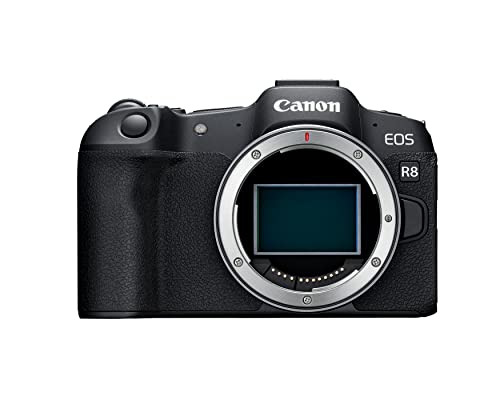
Canon EOS R8 Full-Frame Camera
Best for: Full-frame shooters needing compact size
- Sensor Format
- Full Frame (what this guide is about)
- Sensor Resolution
- 24.2 MP
- Autofocus System
- Dual Pixel CMOS AF II (1,053 AF zones)
- Video Resolution
- 4K up to 60 fps, Full HD up to 180 fps
- Image Processor
- DIGIC X
- Configuration
- Body Only
View on Amazon: Canon EOS R8 Full-Frame Camera Affiliate link
The Canon EOS R8 is a compact full-frame mirrorless camera with a 24.2 MP sensor and DIGIC X processor. It features Dual Pixel CMOS AF II for subject detection and uncropped 4K video at 60 fps. Weighing 2.15 pounds, it is Canon’s lightest full-frame RF mount body. It suits photographers who want full-frame image quality in a portable package.
Pros
- 24.2 MP full-frame CMOS sensor
- DIGIC X image processor
- Dual Pixel CMOS AF II with 1,053 zones
- Uncropped 4K video at 60 fps
Cons
- Heavier than APS-C alternatives
- Body only configuration
- Smaller sensor than medium format options
Good fit if
- You want full-frame image quality
- You value compact camera size
- You shoot 4K video regularly
Skip if
- You need a kit with a lens
- You prefer APS-C portability
- You shoot Micro Four Thirds systems
Verdict: Canon EOS R8 Full-Frame Mirrorless is a lightweight entry into full-frame photography. It fits users who prioritize sensor size and video specs over lens kit inclusion.

Sony Alpha APS-C Vlog Camera
Best for: vloggers needing 4K oversampling and USB streaming
- Sensor Format
- APS-C (what this guide is about)
- Sensor Resolution
- 24.2MP
- Video Resolution
- 4K
- Image Processor
- BIONZ X
- Intended Use
- Vlogging
- Color
- Black
View on Amazon: Sony Alpha APS-C Vlog Camera Affiliate link
The Sony ZV-E10 is an APS-C mirrorless camera built for video creators. It features a 24.2MP sensor and a BIONZ X processor. The camera records 4K video oversampled from 6K data. It includes a dedicated Background Defocus button and a Product Showcase mode for smooth focus transitions. You can stream live via a single USB cable. This model suits vloggers who need reliable autofocus and simple operation.
Pros
- 24.2MP APS-C Exmor CMOS sensor
- 4K video oversampled from 6K with no pixel binning
- Dedicated Background Defocus button for instant effect toggling
- Product Showcase mode shifts focus from face to object
- Live streaming via single USB cable without extra software
Cons
- Heavier build at 2 pounds compared to lighter compact options
- APS-C sensor is smaller than full-frame alternatives
- Lacks a built-in viewfinder
Good fit if
- You prioritize video features over still photography
- You want a lightweight body for handheld shooting
- You need easy live streaming capabilities
Skip if
- You require a full-frame sensor for shallow depth of field
- You need a built-in viewfinder for bright sunlight
- You prefer a DSLR-style grip and optical viewfinder
Verdict: Sony ZV-E10 APS-C Vlogging Camera is a focused tool for video creators who value oversampled 4K clarity and dedicated vlogging controls. It fits users who need a lightweight, USB-streaming body and do not require a viewfinder.

OM System OM-3 Micro Four Thirds Kit
Best for: handheld shooting with internal ND filters
- Sensor Format
- Micro Four Thirds (what this guide is about)
- Sensor Resolution
- 20MP
- Image Stabilization
- IBIS up to 7.5 EV Steps
- Configuration
- Lens Kit
- Color
- Silver
- Dimensions
- 11.3 × 7 × 5.25 inches
View on Amazon: OM System OM-3 Micro Four Thirds Kit Affiliate link
The OM System OM-3 is a Micro Four Thirds mirrorless camera. It uses a 20MP stacked BSI Live MOS sensor. This setup delivers sharp images with low noise. The body includes in-body image stabilization up to 7.5 EV steps. It also features internal Live ND and Live GND filters. This kit suits photographers who need compact gear with strong stabilization.
Pros
- 20MP stacked BSI Live MOS sensor for sharp images
- IBIS up to 7.5 EV steps for handheld shooting
- Internal Live ND and Live GND filters for daylight long exposures
- Super Sonic Wave Filter keeps sensor clean
Cons
- 20MP resolution is lower than many full-frame competitors
- Micro Four Thirds sensor is smaller than full-frame
- Weighs 3.34 pounds with the 12-45mm lens attached
Good fit if
- You want strong in-body stabilization for handheld video
- You need internal ND filters for daylight long exposures
- You prefer a compact Micro Four Thirds system
Skip if
- You require full-frame sensor size
- You need high-resolution 20MP+ stills
- You want a lightweight body-only setup
Verdict: The OM System OM-3 Micro Four Thirds fits photographers who prioritize stabilization and internal filters over maximum resolution. It is a solid choice for handheld work in bright light.

Sony a7 III Full-Frame Mirrorless Camera
Best for: Full-frame image quality and speed
- Sensor Format
- Full Frame (what this guide is about)
- Sensor Resolution
- 24.2MP
- Burst Shooting Speed
- Up to 10fps
- Autofocus System
- 693 phase / 425 contrast AF points
- ISO Sensitivity
- ISO 50 to 204,800
- Color
- Black
View on Amazon: Sony a7 III Full-Frame Mirrorless Camera Affiliate link
The Sony a7 III is a full-frame mirrorless camera with a 24.2MP back-illuminated sensor. It offers ISO 50 to 204,800 sensitivity and 693 phase-detection AF points. The body measures 5 by 3.8 by 2.9 inches and weighs 1.43 pounds. This model suits photographers who need high dynamic range and fast burst shooting up to 10fps.
Pros
- 24.2MP full-frame sensor with 15-stop dynamic range
- ISO range from 50 to 204,800
- 693 phase-detection and 425 contrast AF points
- Up to 10fps continuous shooting
Cons
- Heavier at 1.43 pounds compared to compact mirrorless options
- Fixed 3-inch LCD screen with no articulation
- No mention of built-in Wi-Fi or Bluetooth connectivity
Good fit if
- You need full-frame image quality for low light
- You shoot fast action requiring 10fps burst mode
- You prefer a robust, traditional camera grip
Skip if
- You require a lightweight travel camera under 1 pound
- You need a fully articulating screen for vlogging
- You want a Micro Four Thirds system for smaller lenses
Verdict: Sony a7 III Full-Frame Mirrorless delivers professional full-frame specs in a durable body. It fits photographers who prioritize sensor size and autofocus coverage over compact portability.

Canon EOS Rebel T7 with 18-55mm Lens
Best for: beginners wanting a full kit
- Sensor Format
- APS-C (what this guide is about)
- Sensor Resolution
- 24.1MP
- Autofocus System
- 9-point
- Video Resolution
- Full HD 1080p
- Image Processor
- DIGIC 4+
- Configuration
- Bundle
View on Amazon: Canon EOS Rebel T7 with 18-55mm Lens Affiliate link
The Canon EOS Rebel T7 is an APS-C DSLR with a 24.1MP sensor and DIGIC 4+ processor. It records Full HD 1080p video and uses a 9-point autofocus system. This bundle includes an 18-55mm lens and accessories. It suits beginners who want a complete kit. The 1.05-pound body offers a manageable weight for everyday photography.
Pros
- 24.1MP APS-C CMOS sensor
- DIGIC 4+ image processor
- 9-point autofocus system
- Full HD 1080p video recording
- Includes 18-55mm lens
Cons
- Only Full HD 1080p video
- Basic 9-point autofocus
- Older DIGIC 4+ processor
Good fit if
- You want a complete starter kit
- You prefer an optical viewfinder
- You shoot in good light
Skip if
- You need 4K video
- You want advanced autofocus
- You prefer a mirrorless body
Verdict: Canon EOS Rebel T7 DSLR APS-C fits beginners needing a full bundle. It offers solid 24.1MP images and basic video for casual shooters.

Panasonic Lumix G7 Mirrorless Body
Best for: Compact 4K video and travel photography
- Sensor Format
- Micro Four Thirds (what this guide is about)
- Sensor Resolution
- 16 MP
- Burst Shooting Speed
- Up to 8 fps
- Autofocus System
- DFD AF System
- Video Resolution
- 4K UHD at 30/24 fps
- ISO Sensitivity
- ISO 25600
View on Amazon: Panasonic Lumix G7 Mirrorless Body Affiliate link
The Panasonic Lumix G7 uses a Micro Four Thirds sensor to balance size and image quality. It features a 16 MP Live MOS sensor and shoots 4K UHD video at 30 fps. The body includes a 3.0-inch free-angle touchscreen and a 2.36m-dot OLED viewfinder. This setup suits you if you want compact gear with strong video capabilities and reliable autofocus for everyday use.
Pros
- Micro Four Thirds sensor format for compact body size
- 4K UHD video recording at 30/24 fps
- 3.0-inch free-angle touchscreen for flexible shooting angles
- Up to 8 fps burst shooting with AF
- Built-in Wi-Fi connectivity for easy transfers
Cons
- 16 MP resolution is lower than modern competitors
- No 4K 60 fps video option available
- Burst speed capped at 8 fps
Good fit if
- You prioritize 4K video recording in a small body
- You want a lightweight camera for travel
- You need a free-angle touchscreen for vlogging
Skip if
- You require high-resolution stills above 20 MP
- You need 4K 60 fps video for smooth slow motion
- You prefer full-frame sensor image quality
Verdict: The Panasonic Lumix G7 Micro Four Thirds delivers solid 4K video and a versatile touchscreen in a compact Micro Four Thirds body. It fits you if you value portability and video performance over maximum still image resolution.
Specifications side by side
| Spec | Canon EOS R8 Full-Frame Camera | Sony Alpha APS-C Vlog Camera | OM System OM-3 Micro Four Thirds Kit | Sony a7 III Full-Frame Mirrorless Camera | Canon EOS Rebel T7 with 18-55mm Lens | Panasonic Lumix G7 Mirrorless Body |
|---|---|---|---|---|---|---|
| Sensor Format | Full-frame | APS-C | Micro Four Thirds | Full-frame | APS-C | Micro Four Thirds |
| Sensor Resolution | 24.2 MP | 24.2MP | 20MP | 24.2MP | 24.1MP | 16 MP |
| Burst Shooting Speed | not stated | not stated | not stated | Up to 10fps | not stated | Up to 8 fps |
| Autofocus System | Dual Pixel CMOS AF II (1,053 AF zones) | not stated | not stated | 693 phase / 425 contrast AF points | 9-point | DFD AF System |
| Image Stabilization | not stated | not stated | IBIS up to 7.5 EV Steps | not stated | not stated | not stated |
| Video Resolution | 4K up to 60 fps, Full HD up to 180 fps | 4K | not stated | not stated | Full HD 1080p | 4K UHD at 30/24 fps |
| ISO Sensitivity | not stated | not stated | not stated | ISO 50 to 204,800 | not stated | ISO 25600 |
| Image Processor | DIGIC X | BIONZ X | not stated | not stated | DIGIC 4+ | Venus Engine 9 |
| Configuration | Body Only | not stated | Lens Kit | not stated | Bundle | Body Only |
| Included Lens | not stated | not stated | not stated | not stated | 18-55mm Lens | not stated |
| Resolution | 24.2 MP | not stated | not stated | not stated | not stated | not stated |
| Intended Use | not stated | Vlogging | not stated | not stated | not stated | not stated |
| Color | Black | Black | Silver | Black | Black | Black |
| Lens Mount | Canon RF Mount | not stated | not stated | not stated | not stated | not stated |
| Dimensions | 3 × 6 × 4 inches | 4.5 × 2.5 × 6.7 inches | 11.3 × 7 × 5.25 inches | 2.9 × 5 × 3.8 inches | not stated | 4.91 × 3.04 × 3.39 inches |
| Weight | 2.15 pounds | 2 pounds | 3.34 pounds | 1.43 pounds | 1.05 pounds | 2.85 pounds |
| Model | EOS R8 | ZV-E10 | OM-3 | ILCE7M3/B | EOS Rebel T7 | DMC-G7K |
| Size | not stated | not stated | not stated | not stated | not stated | Body Only |
Frequently asked questions
Does a larger sensor always mean better images?
Larger sensors generally capture more light, which improves low-light performance and dynamic range. This results in cleaner images with less noise. However, resolution also matters. The Canon EOS R8 uses a full-frame sensor with 24.2 MP. This balance provides high quality without excessive file sizes for most users.
How does sensor size affect lens compatibility?
Your sensor format dictates the lens mount system. Full-frame cameras like the Canon EOS R8 use the Canon RF Mount. APS-C bodies, such as the Sony ZV-E10, use different mounts. Micro Four Thirds models, like the OM System OM-3, require specific lenses. You cannot mix mounts across formats without adapters.
Is APS-C good for vlogging?
Yes, APS-C sensors offer a good balance of quality and size. The Sony ZV-E10 is designed for vloggers. It features 4K oversampling for clear video. The body is lightweight, weighing 2 pounds. This makes it easy to hold for long recording sessions while still capturing detailed footage.
What is the benefit of Micro Four Thirds for travel?
Micro Four Thirds cameras are often more compact and portable. The Panasonic Lumix G7 weighs 2.85 pounds. It offers solid 4K video performance in a small body. The OM System OM-3 includes internal ND filters. This allows handheld shooting in bright light without needing external filters.
Can full-frame cameras be lightweight?
Yes, modern full-frame bodies can be quite light. The Canon EOS R8 weighs 2.15 pounds. It is a lightweight entry into full-frame photography. The Sony a7 III is even lighter at 1.43 pounds. These cameras prioritize sensor size while keeping the body manageable for travel.
Do I need a kit lens with my camera?
It depends on your needs. The Canon EOS Rebel T7 comes with an 18-55mm lens. This bundle is ideal for beginners. The Canon EOS R8 is body only. You must buy lenses separately. The OM System OM-3 includes a lens kit. Choose based on whether you want an immediate setup.
How does sensor format impact depth of field?
Larger sensors create shallower depth of field more easily. This means you can blur the background more effectively. Full-frame cameras like the Canon EOS R8 excel at this. APS-C and Micro Four Thirds sensors also produce background blur. You just need wider aperture lenses to achieve the same effect.